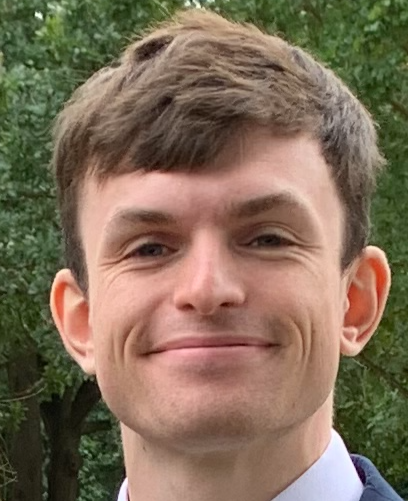
About Me
I’m a postdoctoral researcher working at the Institute of Science and Technology Austria as an ISTA-Fellow. Before I started working in Austria, I was a PhD student at the University of Oxford and an undergraduate/Masters student at the University of Cambridge.
My primary research focus concerns the dynamics of compact objects within the centers of galaxies, where the presence of gaseous discs around supermassive black holes can provide an exotic and intriguing environment for the formation and hardening of gravitational wave sources. Active galactic nuclei have the potential to produce merging stellar-mass black hole binaries by capturing single black holes into their disc, forming them into binaries and then hardening them to merger. Understanding the efficiency of binary black hole formation is crucial in determining the importance of the AGN channel for gravitational wave events.
I conduct my research from a primarily computational viewpoint, investigating the complex interplay between n-body dynamics and gas hydrodynamics using the simulation code Athena++.
I am also the developer of cuDART, a GPU-accelerated relativistic ray tracing code designed for producing synthetic observations from simulations of high-energy astrophysical phenomena. Public code release expected Fall 2026, earlier propietary code versions used in Gasealahwe et al. 2025 and Elley et al. 2025.
This website hosts a list of my published papers, previous talks and some visualisations. If you have any questions about the work I do, please get in touch.
Binary black hole formation due to dissipation by gas gravitation for two black holes embdedded within the disc of an active galactic nucleus. Hydrodynamic simulation performed with Athena++ using a field of adiabatic gas within a corotating shearing frame. Images post-processed using DART, a homebrew python-based raytracing code. Read the parent paper here.